
Buridan's Ass Trap
Analysis Paralysis is Real

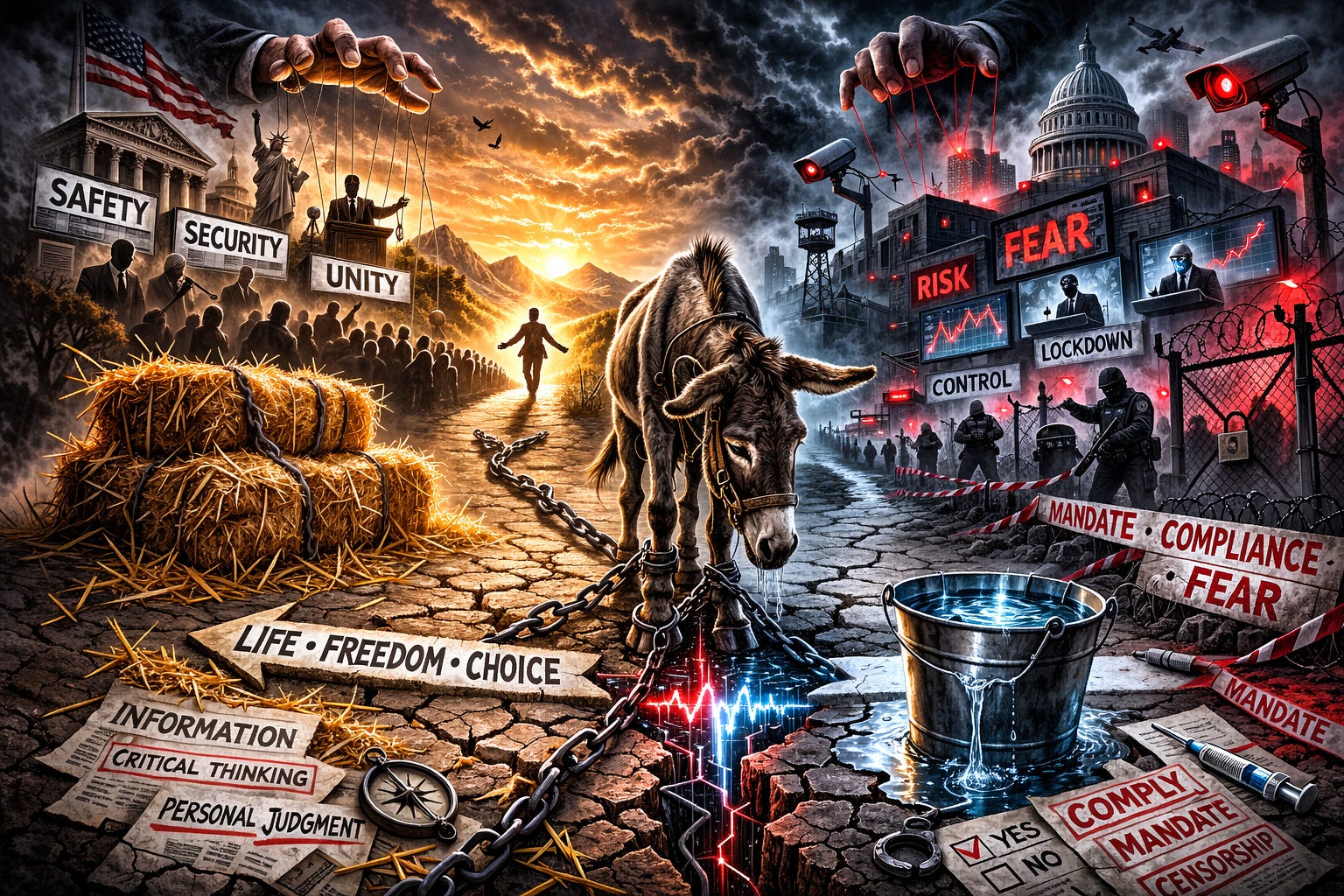
Buridan’s ass is not a joke about stupidity. It is a philosophical examination of what happens when decision making is reduced to comparing options that appear equally weighted.
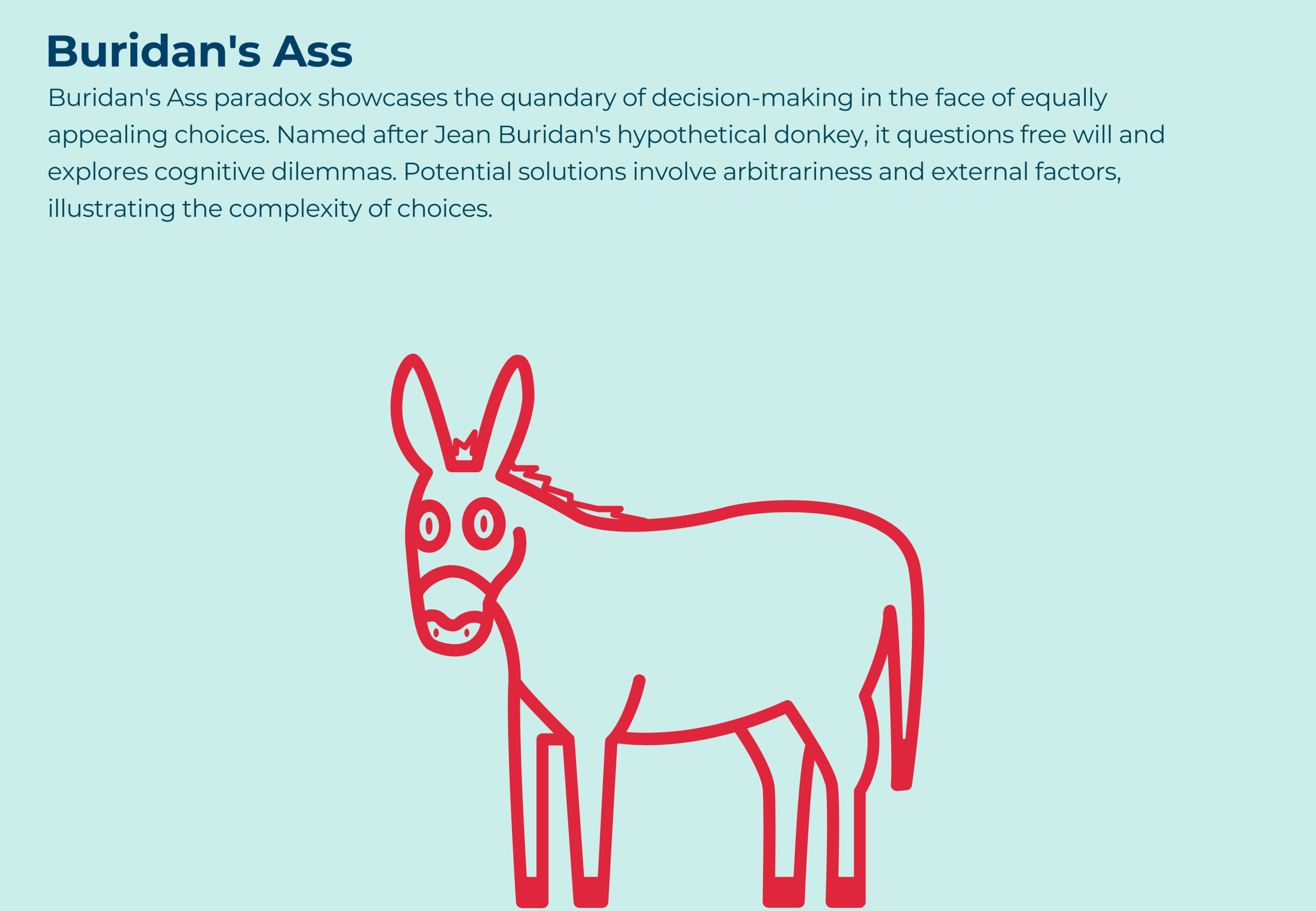
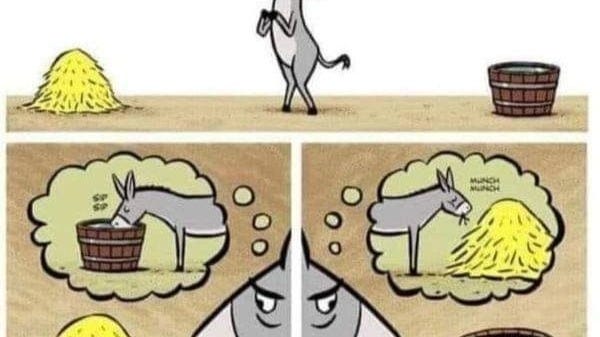
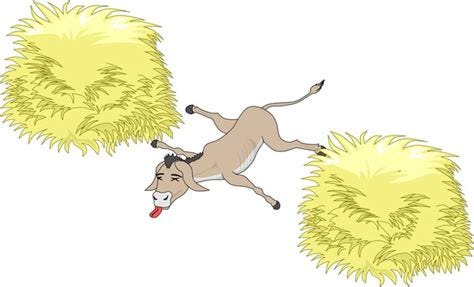
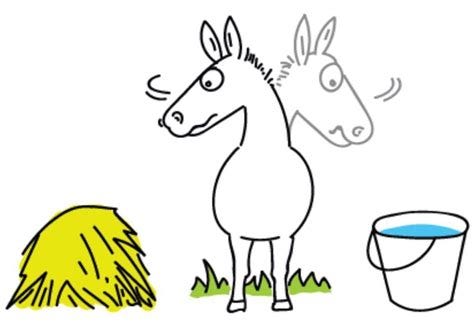
The scenario, discussed long before Jean Buridan and later attributed to him, describes a donkey placed exactly between a pile of hay and a bucket of water (or often two equally delicious looking stacks of hay). It is equally hungry and equally thirsty (or just hungry and can’t decide where to eat). The distance to each option is identical. The relief each provides is identical. If the animal operates under a rule that says it may only act when one option is demonstrably superior, it freezes. It does not die because food and water disappear (or one stack of hay looks better than the other). It dies because the system it uses to justify action demands perfect asymmetry before movement. Analysis paralysis is real.
Philosophers before Buridan addressed similar ideas. Aristotle mocked the idea that equilibrium alone prevents action, comparing it to a man equally hungry and thirsty who must somehow remain frozen between food and drink.
Al-Ghazali argued that free will breaks such stalemates through internal differentiation. Averroes disagreed. Spinoza later accepted the paradox but folded it into determinism. Leibniz argued that subtle unconscious preferences explain why people ultimately choose.

The debate itself reveals something important. The problem is not whether choice exists. The problem is whether choice is allowed to operate when options are framed as identical in weight but unequal in consequence.

In theory, the ass could randomly pick. In practice, rational systems often discourage randomness and demand justification. That demand creates paralysis when justification cannot be produced with certainty.
Lamport later formalized this principle in systems theory. He showed mathematically that when a discrete decision depends on continuous input, there will always be starting conditions under which indecision persists indefinitely. In engineering, this appears as metastability. A circuit sits between 0 and 1, unable to resolve immediately, until noise pushes it toward one state. The analogy is powerful.
During COVID, public policy operated under conditions that resembled forced binary framing. The threat was presented as urgent. The response was presented as necessary. The alternatives were framed as dangerous or irresponsible. People were told they had a choice. But the cost structure attached to each option was not neutral. Align with policy and retain access, employment, travel, and social participation. Question policy and risk marginalization, censorship, or reputational damage. That is not a symmetrical decision space.
When incentives are distributed unevenly, behavior becomes predictable. Predictable behavior can look like consensus. It can also look like compliance under pressure. The deeper concern is not whether action was required. The deeper concern is how crisis conditions compress debate and elevate centralized authority to the point where dissent is treated as obstruction. It’s can become the Buridan’s ass trap.
Power rarely announces itself as permanent. It expands under urgency and embeds itself into infrastructure, regulation, funding flows, and institutional norms. Like metastability in digital systems, the state of emergency can linger long after the initial trigger fades. If oversight mechanisms do not actively retract expanded authority, temporary structures become baseline governance. Buridan’s lesson is not that people should freeze. It is the opposite.
When options are framed as equally dangerous or equally urgent by institutions, individuals must resist the assumption that they are required to wait for official clarity before acting. Sometimes the rational move is not to stand in the middle evaluating infinite projections. Sometimes it is to recognize that perfect information never arrives. Then choose. Drink the water. Eat the food. Protect your interests. Make decisions based on your assessment of reality rather than on the pressure of narrative consensus. Free will is not the absence of risk. It is the willingness to act despite uncertainty.
Brilliant! Though I had had a vague recollection of the Ass dilemma, I hadn't thought of it in many decades. I appreciate the refresher! Indeed, We cannot expect perfect data to make Our choices upon, and need to hope We have enough, or the right, data to make Our choices, while We go ahead and make them.
...or in the event whar we're between a dragon of a dilemma an' a hard place we might jus' hope our wonky ogre pal comes ta the rescue 'fore we need a Bayer "Assburn!"
https://www.youtube.com/watch?v=tR5Sx56ARHI