
Happy Lymph, Happy Life
Welcome to Another Episode of Things Nobody Bothered to Teach Us (Cleavers Edition)

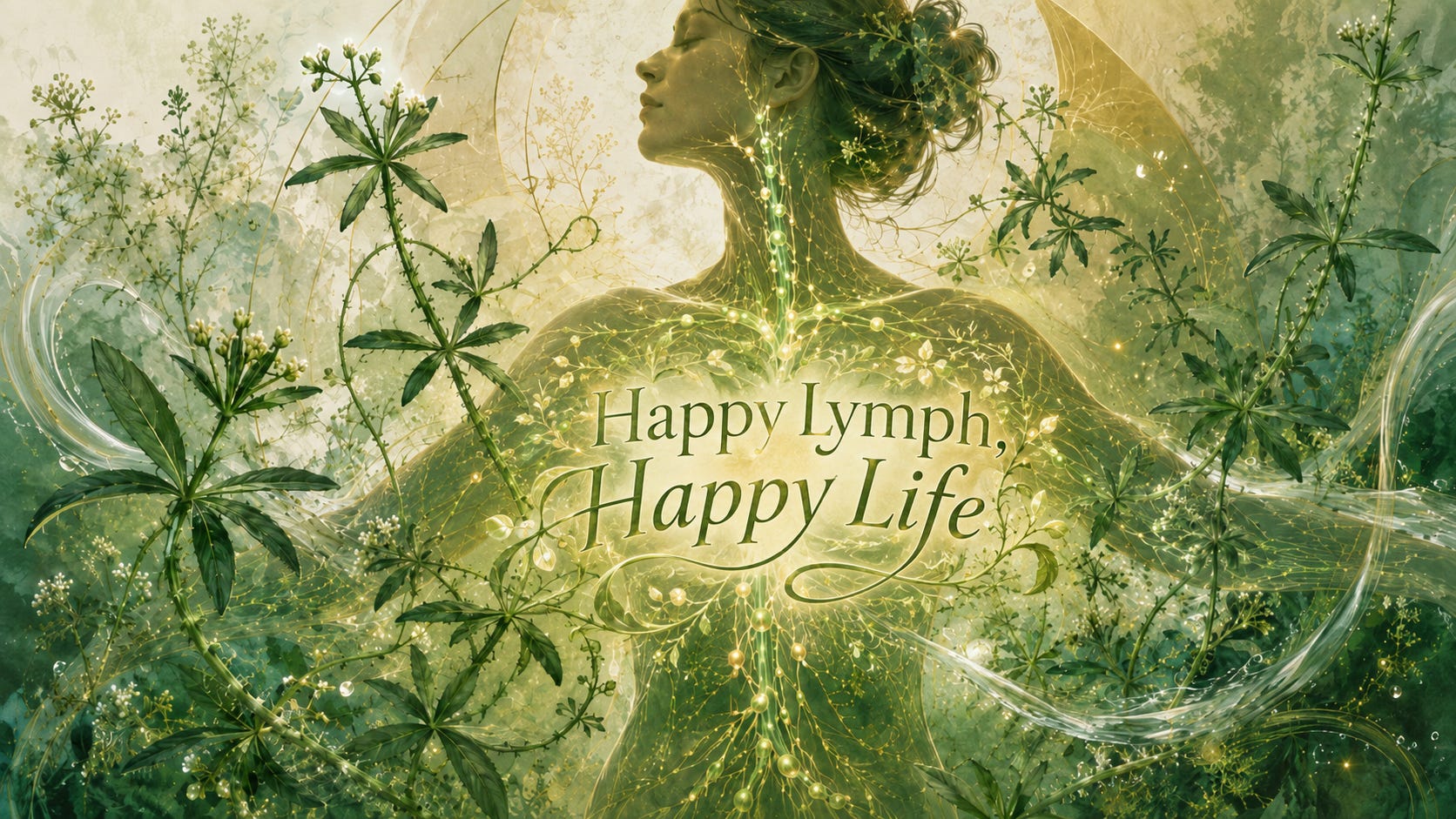
So today I learned about cleavers. Not meat cleavers, although depending on how far down the healthcare rabbit hole I go, I am not ruling anything out. I mean the herb, Galium aparine, which also goes by goosegrass, catchweed, stickyweed, bedstraw and a handful of other names that basically translate to “that clingy green annoyance attached to your pants.”
Cleavers grows across a huge part of the world and is native to much of Europe, Asia, and North Africa, while also being widespread throughout North America, including most of the United States and Canada. It tends to thrive in slightly wild or disturbed places such as fence lines, hedgerows, creek banks, woodland edges, trails, fields, gardens, ditches, vacant lots, and shady or partly shady areas with moist soil. It especially likes growing among other plants because its tiny hooked hairs allow it to grab onto nearby vegetation and sprawl upward, sometimes forming long, tangled mats several feet in length. Cleavers also grows naturally throughout the western United States, including Idaho, and is usually easiest to spot during spring and early summer when it is bright green and actively growing. One of the easiest ways to identify it is by its narrow leaves, which grow in little circular whorls around the stem, usually six to eight at a time, along with its unmistakably grabby, almost Velcro-like texture. Interestingly, cleavers belongs to the Rubiaceae family, which means that annoying little weed stuck to your socks is actually a relative of coffee.
It is covered in tiny hook-like hairs that grab onto clothing, animal fur and neighboring plants, which is why anyone who has spent time walking through fields or trails has probably met it without realizing they were brushing past a plant with a very long medicinal history. And naturally, one of the things it became famous for is supporting a system most of us barely hear about unless something has already gone wrong. The lymphatic system. Of course. Because the more I learn about old herbal traditions, the more I keep running into the same irritating question: how did generations of people who had no imaging equipment, no lab panels and no medical databases still manage to pay extremely close attention to things that modern people somehow never hear about during years of routine healthcare? I knew what cholesterol was before I had any real understanding of lymph, which is honestly ridiculous when you stop and think about it.
Most of us grow up hearing about blood pressure, blood sugar, heart rate, oxygen levels, cholesterol, weight and all the other measurements modern medicine loves because they fit beautifully into a box on a chart, while the lymphatic system is over there quietly moving fluid, transporting immune cells, carrying fats from the digestive tract, filtering material through lymph nodes and helping manage what is happening in the tissues throughout the body.
Then somebody feels a lump in your breast or armpit and suddenly everybody remembers the lymphatic system exists. Within about thirty seconds, the conversation has gone from “what even is the lymph system” to “we should probably make sure this is not cancer,” which leaves a pretty enormous gap in the middle where basic education about how the system works might have been useful. The lymphatic system is not some weird bonus feature tucked into the body for no particular reason. It is an enormous network of vessels, nodes and tissues involved in fluid balance, immune activity, fat transport and the movement of material away from tissues and back toward circulation.
Your blood has the heart doing the heavy lifting, pumping continuously and keeping circulation moving whether you are sitting on the couch, sleeping or staring blankly at your phone for six hours. Lymph does not have one giant centralized pump doing that job. Its movement depends on the contraction of lymphatic vessels themselves, pressure changes created by breathing, skeletal muscle activity, movement of the body and one-way valves that help keep fluid traveling in the right direction. Which means the very ordinary things humans used to do constantly before we became professional chair dwellers actually matters.
Walking is key because muscles contracting throughout the legs and body help create the pressure changes that move fluid through vessels. Deep breathing is key because the diaphragm changes pressure inside the chest and abdomen in ways that affect fluid movement. Stretching, bending, lifting, climbing, working with your hands, carrying things, tending a garden, dancing in your kitchen and generally inhabiting your body instead of parking it in a chair all day are not just ways of burning calories; they are part of how the machinery actually operates.
Once you understand this essential concept, the old health practices that get tossed into the giant modern dumpster labeled “woo” start looking a lot less ridiculous. Massage, movement, sweating, breathing practices, hot and cold bathing, herbs traditionally used for swelling and fluid movement, and simply paying attention to whether the body feels puffy, heavy, stagnant or inflamed all came from people noticing patterns in actual human bodies. Maybe Grandma was not an uneducated moron simply because she did not have access to PubMed or a medical license from a fancy university. Which brings me back to cleavers.
Traditional herbalists have used cleavers for centuries in connection with swollen glands, puffiness, irritated skin, urinary complaints and what later herbal language came to describe as lymphatic congestion. People often describe it as helping “sweep out the goo,” and while that is obviously not an anatomical term, I actually like it because at least it gets straight to the point.
Your tissues are busy places. Cells are constantly taking nutrients in, producing waste, communicating with one another, dying, regenerating, metabolizing and releasing compounds into the surrounding environment. Fluid moves out of blood vessels and into the spaces around cells, and not everything simply hops directly back into the bloodstream.
The lymphatic system helps collect what is left hanging around in those spaces, including fluid, proteins and other material, and moves it through the lymphatic network. So when people use the rather glamorous phrase “sweeping out the goo,” they are not describing an imaginary concept pulled out of thin air. They are describing, in very non-medical language, the fact that the body has a real drainage and transport system that is constantly collecting material from tissues and moving it somewhere else.
That does not mean cleavers is wandering through your body with a tiny broom and dustpan. It means the plant developed a long-standing reputation in herbal practice for situations involving swelling, glands and fluid movement, which is a pretty interesting reputation for a weed most of us have been taught to yank out of the ground and throw away. Cleavers really is basically a weed. It does not grow in some inaccessible jungle or far off land where it has to be harvested by monks during a lunar eclipse and sold to you in a four-ounce bag for $86.99 plus shipping. It grows along fences, trails, gardens, hedgerows and fields, where people have probably cursed at it for thousands of years because it sticks to everything that touches it. Its clingy personality is so distinctive that ancient people named it for that behavior.
Theophrastus was writing about a plant called aparine more than two thousand years ago, and Dioscorides described the plant in the first century in De Materia Medica. Carl Linnaeus later gave it the formal botanical name Galium aparine in 1753, but he did not “discover” cleavers any more than somebody who labels a river on a map gets credit for inventing the river.
Humans have honed in on good and not so good plants over millenia. Humans had been watching the magical wonder weed cleavers, using it and passing information about it down for generations. That is the essential component of traditional medicine that I think gets dismissed far too casually. People in the past may not have had modern laboratories, but they had something incredibly powerful that we seem determined to treat as intellectually inferior: long-term observation.
Imagine living around the same plants your entire life, then teaching your children what you learned, who eventually teach their children, while the entire community keeps observing what happens when different plants are eaten, brewed, crushed, applied to skin or taken during certain illnesses.
This is the part people seem to forget: old herbal knowledge did not just appear out of nowhere because somebody felt mystical one afternoon. People lived closely with these plants, used them over and over, and paid attention to what happened. If a plant consistently made people sick, they learned to avoid it. If another one made people urinate more, settled an upset stomach, calmed irritated skin, helped with swelling, or made it easier to sleep, people remembered that too and passed it along. Over generations, those observations became a kind of practical record, refined by experience and repetition. Some of it was probably wrong, some of it was incomplete, and some of it stuck around for centuries because people kept seeing the same results. There is nothing especially mysterious about that. It is simply human beings noticing patterns and learning from them.
The strange part is that we now act as though knowledge only became legitimate after it moved into a laboratory and acquired a billing code. Was every traditional remedy brilliant? Obviously not. But I always find it funny when people use that argument as though modern medicine has never recalled a medication, reversed a recommendation, discovered an unforeseen complication or spent twenty years confidently telling everybody one thing before quietly deciding the opposite was true.
Humans have always been figuring out the body as we go. Traditional healers did it through observation and inherited knowledge, while modern medicine does it through laboratories, imaging, clinical data and increasingly specialized research. Those things do not have to cancel one another out. What bothers me is the automatic assumption that the older knowledge was primitive simply because it came first.
Plants are chemically complicated organisms. They manufacture flavonoids, iridoids, terpenes, tannins, phenolic compounds and thousands of other molecules because plants have their own biological problems to solve, and humans spent an enormous portion of our history figuring out which of those plants produced noticeable effects in us. Then modern pharmaceutical chemistry came along and began isolating, concentrating, modifying and reproducing biologically active compounds. That is perfectly fine.
What is strange is pretending the plant knowledge that helped lead us there was suddenly silly. Apparently the molecule becomes sophisticated once someone puts it in a bottle with tiny print and a copay. Funny how that works. And no, I am not claiming cleavers is some magical lawn weed that cures everything from world peace to your ex-husband, although I remain open to reviewing the evidence on that second indication.
It is super interesting that generations of herbal traditions paid very close attention to swelling, fluid movement, elimination and what they perceived as congestion in the body. Once you actually learn what the lymphatic system does, that focus seems considerably less strange. The lymph system runs throughout the body. There are lymphatic vessels woven through tissues, lymph nodes clustered in the neck, armpits, chest, abdomen and groin, and lymphatic tissue associated with the digestive tract and immune system. The digestive system itself is closely connected with lymphatic transport because specialized lymph vessels in the intestine help absorb and carry dietary fats. This is not an obscure little system that can be ignored until somebody discovers an enlarged node.
It is part of everyday physiology. Yet when was the last time anybody sat down during a routine medical appointment and explained how lymph moves? When were you told that muscle contraction helps move lymphatic fluid, or that diaphragmatic breathing creates pressure changes that influence lymphatic circulation, or that spending the majority of the day motionless is a problem for reasons that extend far beyond weight gain?
We hear endless lectures about exercising because it burns calories, as though the human body is primarily a poorly managed checking account for food. There is so much more going on. Movement changes circulation, muscle activity, glucose handling, nervous system signaling, breathing mechanics and fluid dynamics throughout the body. Your body was built around motion. The same is true of the boring health habits that rarely sell very well because nobody can patent.
Eating real food gives the body the raw materials it needs to build, repair and regulate itself. Drinking enough fluid matters because every circulation and transport system in the body depends on water. Sleeping matters because repair, bioelectrical harmony throughout the body, hormonal regulation, nervous system function and waste-clearance processes do not simply shut down because we decided staying awake until two in the morning scrolling through nonsense was more important. Digestion and elimination matter because what enters the body eventually has to be processed, absorbed, transformed or removed. Swelling matters because it is information, not merely an aesthetic inconvenience. Changes in energy, skin, bowel habits, fluid retention, pain or inflammation matter because bodies communicate long before they completely fall apart.
That was the central idea behind a great deal of traditional health knowledge: pay attention early. Notice changes in your body (you’re the expert). Keep the body moving (you don’t move that sludge in your detox system and every space and cell in your body remains in stasis and dis-ease). Support digestion and ward of dysbiosis. Support elimination to help rid the body, mind, and soul of those things that no longer serve you. Know what normal feels like for you.
Use food, plants, movement, breath, rest and other ordinary tools before every small imbalance becomes a giant screaming problem. Somewhere along the way, we became exceptionally sophisticated at naming disease while becoming strangely disconnected from the basic maintenance of being alive. That is what keeps bothering me not only as a veteran of modern medicine and a human.
Modern healthcare is incredible when somebody gets hit by a truck, needs an emergency surgery or has an artery that desperately needs to be opened. Nobody is arguing that I want a poultice if my appendix explodes (although I am sure there has to be some purpose for that thing). But our entire relationship with health cannot begin once the body reaches the point of catastrophe. There has to be something between “ignore your body” and “welcome to the hospital.” That middle space is where a lot of old knowledge lived.
Pay attention to what you eat (counting chemicals is just as important as counting calories). Move. Every. Day. All. Day. Get outside (unless like today you are surrounded by smoke from all the fires and smog). Breathe deeply enough that your diaphragm actually moves. Sleep and find time to unwind and find joy around you (mucho important). Foster healthy and loving relationships with yourself and others. Keep stress in check. Notice changes in digestion and elimination. Pay attention to swelling instead of assuming the only relevant question is whether your jeans still button.
Learn the plants that humans used for generations and understand why they used them instead of dismissing the entire subject because somebody on Instagram once sold a detox tea. None of that requires worshipping at the altar of alternative medicine. It requires understanding that the body is a living, interconnected system rather than a collection of unrelated parts waiting for prescriptions. That is probably why I keep finding the lymphatic system so fascinating.
It connects so many things we tend to discuss separately: fluid balance, immune activity, digestion, movement, inflammation and tissue health. This amazing drainage system is constantly working in the background, yet most people know almost nothing about it. And cleavers, this goofy sticky weed that has been annoying humans since ancient Greece, has somehow spent centuries associated with exactly that kind of fluid movement and drainage.
I cannot tell you why nobody teaches us about this stuff earlier (cough…cough…Rockefeller suppressing natural healing modalities decades ago). I can tell you I am now much more interested in what grows along the side of the trail. I am also increasingly convinced that “happy lymph, happy life” is not nearly as silly as it sounds. Because once you realize your body has an entire toxic waste drainage and transport network that depends heavily on movement, breathing and the everyday conditions you create for it, you start looking at health a little differently.
Maybe maintaining the terrain matters (it does). Maybe keeping things moving matters (it does). Maybe noticing swelling before it becomes a medical mystery matters (big red flashing warning signals). Maybe the ordinary things our grandparents considered common sense were not all backward superstition. And maybe the next time that obnoxious sticky weed grabs onto your pants, you should at least introduce yourself before ripping it off. It has apparently been hanging around us for a couple thousand years. The least we can do is learn its name.
Good observation, you struck a balance between the extreme (hospital) and the most common everyday ailments. I like what you said that if we pay attention to the early warnings that extreme treatments might be avoided.
Good info as always!