
Algorithms Gone Wild
Who Needs Privacy Anyway?

There’s a script that repeats itself: spectacle detonates, outrage spreads, and the solution — usually some techno-security cure — is foisted on a frightened public. Watch enough political theater and you see the same beats again and again. Snake Eyes (Brian De Palma, 1998) gave us the template, a staged assassination at a public spectacle, corrupted protectors, and a truth-bearer who peels back the set dressing. That blueprint is now being used in real life: a public assassination, an urgent push to adopt sweeping AI surveillance, and private operators selling a product they say will stop the next spectacle before it happens.
I’m going to say what needs saying: people who have watched this theater for years smell an operation. They aren’t gullible or paranoid for asking why so many moving parts, private vendors, intelligence-linked operators, sudden policy pushes, and symbolic stunts and keep lining up to make mass surveillance feel “necessary.” Read Vigilant Amalek Snow Leopard’s Stack for a granular blow-by-blow and they did excellent work; go follow them. I’m not rehashing every citation; I’m connecting the dots and calling the pattern what it looks like.

HOW SNAKE EYES FUNCTIONS AS A LENS
De Palma’s film doesn’t predict anything mystical — it teaches style. It shows how spectacle can be a smokescreen for conspiracy. The playbook is simple: create a public trauma, use that trauma to justify extraordinary responses, then normalize those responses until the public accepts them as inevitable. The Snake Eyes beat is now standard issue: event → panic → vendor pitch → policy.
WHAT HAPPENED (TIMELINE — TIGHT, SUSPICIOUS)
Leading up to September 10, 2025: Aaron Cohen and allied channels begin publicly pushing GIDEON — an always-on online threat-detection product. The rollout includes TV spots, platform clips, and fundraising chatter.
September 10, 2025: A high-profile assassination (Charlie Kirk) detonates the national news cycle and concentrates public emotion.
September 10, 2025: Senator Ted Cruz unveils a major AI “sandbox” legislative pitch — a framework that, in practice, could accelerate deployment and limit oversight for certain technologies.
Well…Well…Well… While Charlie Kirk Takes the Spotlight

The AI moratorium bill Ted Cruz pushed out on September 10, 2025—wrapped in the so-called SANDBOX Act—is basically a free pass for Big Tech to experiment without meaningful guardrails. It creates a federal “regulatory sandbox” where AI developers can ignore many existing rules under the guise of “innovation.” That means companies working on predictive p…
Early–Mid September 2025: Political elites, from presidential-level figures to state executives and global summits (UN, CGI), flood the space with urgent-sounding AI-security rhetoric.
Late September 2025: The Trump–Epstein statue stunt on the National Mall surfaces and is removed quickly — a symbolic act that landed on the symbolic center of Washington DC.
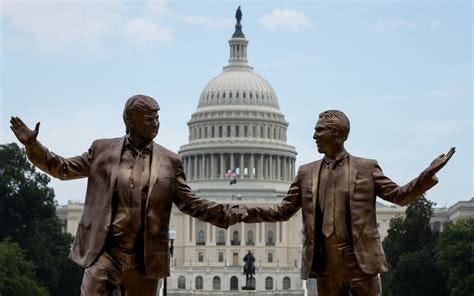
Sequence isn’t proof. But choreography matters. When product pitches and policy moves are timed to land in the immediate aftermath of a spectacle, you have to ask: who benefits? Who gets a lucrative procurement contract while the public is still shocked? All signs are starting to feel like the lead in one general direction lately…

WHO IS AARON COHEN AND WHAT IS GIDEON?
Aaron Cohen (actor)
Aaron Cohen (Hebrew: אהרון כהן; born 28 February 1976) is an American-Canadian actor, ex-Israeli special forces agent, and counterterrorism analyst best known for his on-camera appearances on various major news cable programs.
Early life and education
Cohen was born to a Jewish family in Montreal, Quebec.[1] His parents divorced when he was young and the family moved to Miami and settled in Los Angeles.[1] He then spent the next several years shuttling between California, Canada, and Florida.[1] For secondary school he attended the Robert Land Academy, a military academy in Canada,[1] and graduated Beverly Hills High School in 1995.[2]
He is the stepson of the American filmmaker Abby Mann.[3]
Military Service
After high school, Cohen left Los Angeles for Israel, working on a kibbutz before enlisting in the Israel Defense Forces. After passing the consolidation, a demanding screening process for elite unit candidates, Cohen was one of the few non-Sabra volunteers accepted.[1] In the mid-1990s, he became a member of the undercover Duvdevan Unit (Hebrew: דובדבן; lit. cherry) of the IDF Commando Brigade, performing counter-terror operations targeting suspects among the Palestinian Arab population in the West Bank.[4] He has stated his belief in Zionism and has said his family has a strong Jewish identity.[5]
Post Military
After his service, Cohen returned to Los Angeles and founded IMS Security Consultants, Inc., a Hollywood VIP protection service that has done security work for Hollywood actors, VIPs, rock stars and dignitaries,[6] as well as providing tactical counter-terrorist and “active shooter” training to vetted members of local, State and Federal law enforcement as well as police SWAT teams and the U.S. military Special Forces.[7]
Film and television
Cohen got his Hollywood start tech advising for numerous films including Steven Soderbergh’s Haywire and providing tactical training for actors including Keanu Reeves for the John Wick franchise, and quickly transitioned into acting, supporting in various film and TV projects including 211 with Nicolas Cage, Rambo 5: Last Blood with Sylvester Stallone and a recurring role on the Netflix series Luis Miguel. In 2022 he was cast in a supporting role opposite Antonio Banderas in the crime thriller The Enforcer. [8]
UCLA Gaza encampment
In May 2024, Cohen claimed that he “ran a quiet infiltration operation” into the pro-Palestinian solidarity encampment at UCLA.[9] He then spoke about his experience on Fox News.[10][11]
Gideon is being sold as the perfect techno-solution: a “digital detective that never sleeps.” That tagline disguises a monstrous operational reality.
What Gideon is marketed to do:
Continuously scan vast tracts of open-source data — social posts, forums, public messaging — 24/7.
Identify “patterns” of radicalization and pre-attack indicators by mapping language clusters, network links, and behavioral markers.
Produce “leads” or threat profiles for law enforcement and security clients, supposedly preventing attacks before they happen.
How it’s sold: emotionally. The pitch is “If only they had Gideon, none of this would happen.” Who wouldn’t want a tool that prevents tragedy? That emotional sell is what bends institutions toward purchase and pilots.

Why Gideon is terrifying in practice:
False positives at scale. Language is context-heavy. Humor, irony, grief, and political rhetoric all look like red flags to crude pattern detectors. That means ordinary people — activists, journalists, critics — can be flagged and targeted.
Outsourced policing. When private products feed public enforcement, accountability dissolves. Who audits the model? Who controls the training data? Who answers when an algorithm ruins someone’s life?
Pre-crime logic. The marketing turns grievance and thought into actionable “threat” categories. Welcome to the pre-crime era: suspicion before action; punishment without wrongdoing.
Normalization through fear. After a shock, Gideon-sellers can pass pilots and contracts under the excuse of “preventing the next attack.” Pilots become permanent; temporary emergency measures ossify.
Bottom line: Gideon behaves like fiction made policy. It weaponizes prediction and then sells it back to a frightened public as salvation.
The Dangers are Documented, Auditable, and Unconstitutional
Gideon and similar platforms are not theoretical: they are deployed to scan, scrape, and profile Americans 24/7 in real time. Intelligence-adjacent actors, including operators with Israeli intelligence ties, are deeply involved in the architecture, training, and deployment of these AI pre-policing systems. Their algorithms continuously monitor social media, messaging, and public behavior to flag “potential threats” — people who might commit a crime, even if they haven’t. This is classic pre-crime logic weaponized with 21st-century technology.
The risks are immediate and provable:
Procurement opacity: Contracts shield methods and data sources under “proprietary” and classified designations. Even oversight bodies often lack access.
No independent audits: Accuracy metrics, false-positive rates, and model biases are unpublished or obfuscated. Your private conversations, affiliations, or protest participation could trigger alerts without your knowledge.
Function creep: Originally sold for counterterrorism, these systems now monitor political movements, protests, journalists, and private citizens.
Constitutional mismatch: The Fourth Amendment protects against unreasonable searches, and the First protects free expression. Preemptively scanning everyone’s digital life in the name of threat detection flagrantly violates both principles. This is surveillance without probable cause and the essence of an unconstitutional panopticon.
THE SYMBOLS AND THE NARRATIVE MACHINE
The Trump–Epstein statue on the National Mall wasn’t a mere spectacle — it was a signal in a larger intelligence theater. Symbols orient public attention and help normalize extraordinary measures. Pair that with Gideon-style AI, Israeli intelligence involvement, sealed files, and the political actors quietly enabling this infrastructure, and the pattern is clear: preemptive surveillance is being operationalized under a veneer of “protection” while ordinary Americans are effectively under digital scrutiny 24/7.
WHY ARE LEGISLATORS ALLOWING THIS?
It’s stunning, almost cinematic: legislators, from state houses to Congress, are greenlighting AI surveillance pilots while high-profile incidents — Charlie Kirk’s assassination, public stunts, media distractions — dominate attention. They allow private, intelligence-linked operators to develop pre-crime platforms that monitor citizens in real time, and they do so without clear legal frameworks, oversight, or accountability. Why? Contract incentives, lobbying, fear-driven narratives — and in some cases, perhaps, influence operations quietly pushing the agenda. The result: the erosion of constitutional safeguards in plain sight.
Why should this alarm you?
Scale without safeguards. Automated, continuous scraping of speech and social networks at scale means false positives, mis-contextualized flags, and disproportionate impacts on citizens. Most civil-liberties frameworks weren’t built for an algorithm that treats speech patterns as predictive evidence.
Private actors, public power. Companies and political operators can build capabilities in the private sector and then slide them into public life via contracts and pilot programs — often with limited transparency. When the pitch is emotionally charged, oversight becomes an afterthought.
Normalization by spectacle. High-drama events compress public reaction. That’s when people are most willing to trade liberty for the illusion of safety.
Legal mismatch. Constitutional protections — free speech, due process, protections against unreasonable searches — don’t map cleanly onto a 24/7 algorithmic panopticon. We should be wary of letting crisis-driven urgency be the pretext for permanent legal changes.


All-seeing eye: Israeli startup revolutionizes mass security screening
Scanary unveils a contactless mass security system that can screen up to 25,000 people per hour using AI-powered radar and electromagnetic imaging to detect hidden threats in real time; pilot to begin in Israel and US
Israel Wullman|Updated:07.26.25 | 08:49
All-seeing eye: Israeli startup revolutionizes mass security screening
Scanary unveils a contactless mass security system that can screen up to 25,000 people per hour using AI-powered radar and electromagnetic imaging to detect hidden threats in real time; pilot to begin in Israel and US
Israel Wullman|Updated:07.26.25 | 08:49
Israeli startup Scanary unveiled a groundbreaking technology for mass security screening, capable of processing up to 25,000 people per hour without physical contact or bottlenecks. The system detects hidden objects on individuals in motion across 200 square meters (2,153 square feet), identifying threats in under two seconds and alerting security teams automatically. It was introduced on Wednesday
Led by Dr. Gideon Levita, a former senior radar engineer for the Iron Dome and Trophy defense systems, Scanary’s technology combines radar sensors with artificial intelligence (AI) to scan crowds at a distance of up to 10 meters (33 feet).
If people think the government watching their messages and flagging for pre-crime is bad, just wait till everyone finds out what the right (wrong) electromagnetic frequencies can do.
Pre-crime is just step one. Extrajudicial punishment based on those parameters (with total plausible deniability) is the next step en masse for any wannabe totalitarian government.
They'll be flagged, and then they'll just... get sick. Or suddenly start doing things that make everyone around them convinced they're intentionally self-destructing.
https://youtube.com/watch?v=k4a1xS_Qm1o&t=363
I had a preview of this ride, and it really doesn't matter even if you try if you keep your arms and legs inside the vehicle at all times.
My advice: buckle up, y'all. It's gonna get wild out there.
--🔑
Uh...What can possibly go wrong? Really good question.