
"mRNA" Vaccines Under the Microscope
Nanoparticles Unleashed

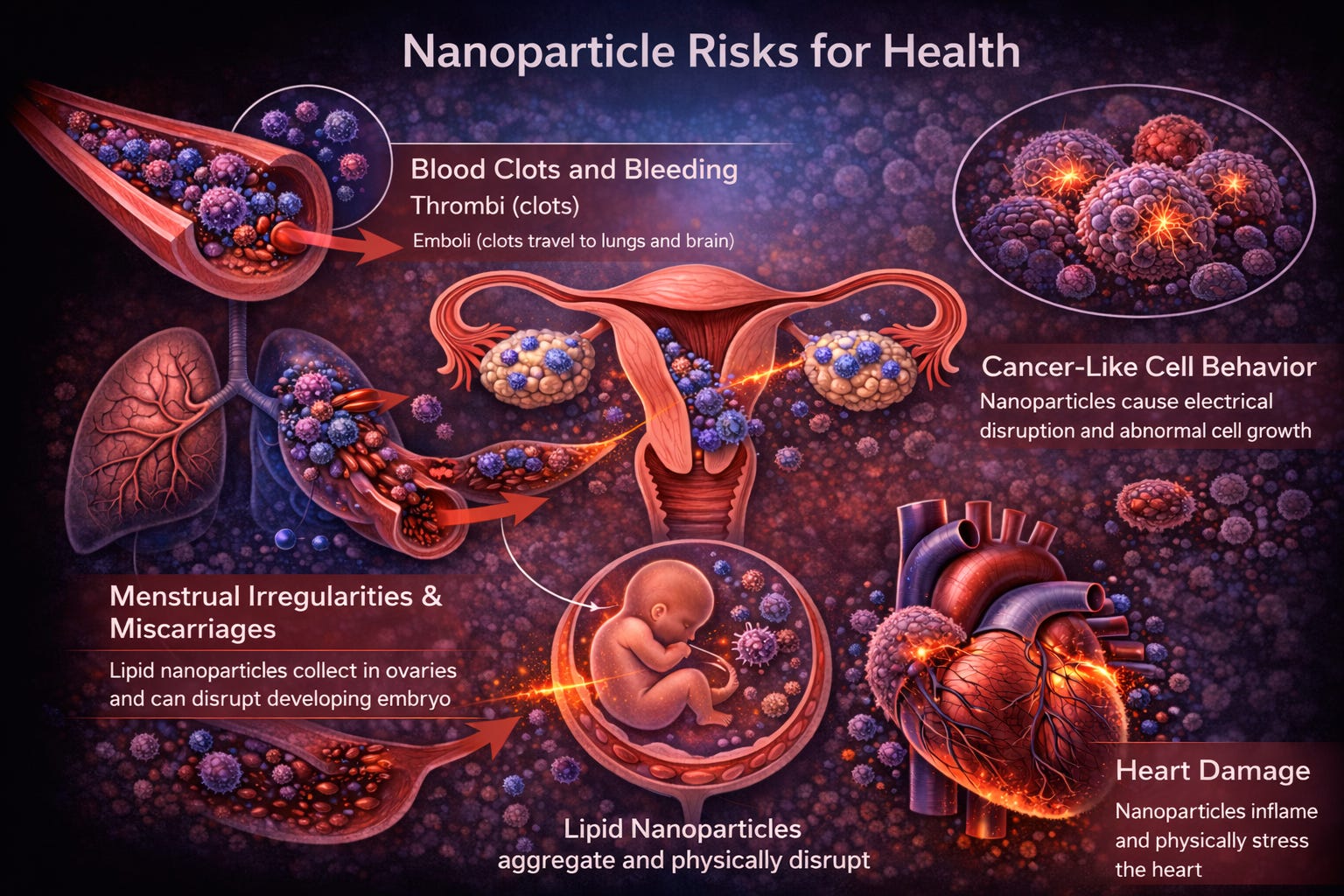
Both Pfizer and Moderna used lipid nanoparticles to deliver supposed mRNA. The mRNA was not the dominant variable. The nanoparticles were. These particles determine where the supposed mRNA goes, how long it circulates, what cells absorb it, and which organs are exposed. Lymph nodes, blood vessels, the heart, liver, spleen, brain, ovaries, etc… are all targets simply because of circulation patterns, tissue perfusion, and particle physics. That is targeting, but it is not designed in a manner shown to be safe or precise.
Lipid nanoparticles are not uniform. Each dose contains billions of individual particles that vary in size, structure, surface chemistry, and electrical behavior. Those differences dictate biological outcomes. Nanoparticles behave differently than bulk materials because surface effects dominate at this scale. Small changes in size or charge radically alter how particles interact with blood, proteins, cell membranes, and immune cells. Once injected, these particles are no longer controlled products. They become reactive materials inside a living system.
How to Sell Invisible Spike Proteins with Fancy Greasy Synthetic Balls
The whole mRNA “spike protein factory” story is nonsense from the ground up. No virus has ever been properly isolated or shown to exist, so the very thing these mRNA strands are supposedly copying, the spike, doesn’t exist. Yet somehow, we are meant to believe that our cells are faithfully following these invisible instructions to churn out a toxic protein that’s never been proven real. Meanwhile, the real work is done by the lipid nanoparticles, little greasy synthetic delivery balls that are cheap, easy to make, and inherently bioactive. They do not need a virus, a spike, or compliant cells; they just do their thing. The mRNA narrative is purely a theatrical layer to make this chemical reality look like sophisticated science. Strip away the jargon and the faith in the imaginary virus, and what you have is expensive storytelling wrapped around industrially trivial chemistry.

Moderna Versus Pfizer: The Nanoparticle Differences That Actually Matter
Moderna (mRNA-1273, SM-102 LNP)
Moderna used a higher supposed mRNA dose and larger lipid nanoparticles on average. Reported particle sizes cluster roughly around 80 to 100 nanometers but with a broad distribution. That means many particles were significantly larger or smaller than the nominal target. Moderna particles also carried a higher total lipid load per dose. More particles plus larger particles means greater total surface area interacting with blood components. This increases protein binding, immune activation, and off-target tissue exposure. Moderna consistently showed higher rates of myocarditis and systemic inflammatory reactions, particularly in young males. Larger and more numerous particles circulate longer, extravasate more easily, and deposit in organs like the heart, liver, spleen, brain, and ovaries.
Pfizer (BNT162b2, ALC-0315 LNP)
Pfizer used a lower supposed mRNA dose and smaller nanoparticles on average, commonly reported around 60 to 80 nanometers. The size distribution was narrower than Moderna but still variable. Smaller particles generally clear faster and may show reduced tissue deposition. That aligns with lower myocarditis rates relative to Moderna. Lower does not mean absent. Both products used ionizable cationic lipids that become positively charged in acidic environments and neutral at physiological pH. This design was meant to aid cell entry but introduces instability once particles encounter real biological conditions.
pKa, Surface Charge, Zeta Potential, and Why Stability Was an Illusion
The surface charge does not belong to the liquid as a whole. It belongs to each nanoparticle. Ionizable lipids are engineered with a specific pKa, which dictates their charge at a given pH. At physiological pH, most of these particles are neutral, which reduces toxicity and prolongs circulation. Inside acidic compartments such as endosomes, the particles become positively charged. That change is meant to allow endosomal escape of the supposed mRNA. In practice, this ionization also changes aggregation behavior in blood and drives unpredictable interactions with proteins and cells.
Zeta potential measures the electrical potential at the slipping plane around an individual particle. It is a proxy for stability. High absolute zeta potential above 30 millivolts suggests particles repel and remain dispersed. Low zeta potential below 5 millivolts allows aggregation. In controlled lab conditions, manufacturers aim for zeta potential values that suggest temporary stability. Those measurements are done in simplified solutions, not in human blood.
The moment nanoparticles enter the bloodstream, everything changes. Proteins bind to their surfaces forming a protein corona that alters effective size, charge, and biological identity. Ionic strength, pH, and inflammatory signals further modify particle behavior. Aggregates that form can lodge in capillaries, stress endothelial cells, and activate platelets. Aggregates later dissociate under different biological conditions releasing smaller, highly reactive particles. This is the Trojan horse problem and it drives toxicity.
Aggregation, Distribution, and Why Dose Control Was Impossible
Nanoparticles dissolve, aggregate, and sediment over time. Even slight handling differences such as storage, freeze-thaw cycles, agitation, or shipping vibration alter particle distributions. There is no mechanism to guarantee that each vial or syringe contained identical nanoparticles. Regulatory approval was based on averages, not per-vial particle measurements. Two people receiving doses from the same batch could get meaningfully different nanoparticle populations, sizes, aggregation states, and ionization behavior. Once injected, control ends.
Side Effects Were Not Random
The observed side effects align with nanoparticle behavior. Systemic inflammation reflects “immune” recognition of synthetic particles. Myocarditis aligns with nanoparticle deposition in cardiac tissue and endothelial cells. Clotting aligns with platelet interaction and endothelial activation. Neurological symptoms align with particles crossing compromised barriers. These outcomes were not rare coincidences. They were predictable consequences of injecting unstable, variable nanomaterials at scale.
Why Young Males ❤️🩹 ❤️🩹 ❤️🩹 Took the Hardest Hit
The higher rates of myocarditis and pericarditis in young males make sense without invoking a cartoon version of the immune system. Young male physiology is different at a baseline level, especially when it comes to testosterone, vascular tone, and electrical signaling in cardiac tissue. Testosterone increases cardiac output, blood pressure reactivity, red blood cell mass, and endothelial responsiveness. It also alters ion channel behavior in heart cells and increases susceptibility to electrical instability under stress. This creates a system that is already operating closer to its upper limits.
Now introduce lipid nanoparticles into that environment. These particles are not passive. They carry surface charge, change charge based on pKa, bind proteins, and physically interact with vessel walls. In young males with higher testosterone, blood flow is faster, vascular shear forces are higher, and capillary pressure is greater. That makes it easier for nanoparticles to leave the bloodstream and enter heart tissue. Once there, their surface charge and aggregation behavior disrupt local electrical signaling, irritate endothelial cells, and interfere with normal cardiac conduction. Testosterone does not protect against this. It amplifies it. It is gasoline on a system already running hot.
This explains why the heart was disproportionately affected in young males and why Moderna, with larger and more numerous nanoparticles, showed higher rates of myocarditis. More particles meant more opportunity for cardiac deposition and more physical disruption of heart tissue. This was not an overreaction of a mystical immune system. It was a predictable interaction between synthetic nanoparticles and a high-output, electrically sensitive cardiovascular system. The damage pattern followed physics and physiology, not ideology.
How Nanoparticles Could Cause Strokes
Strokes happen when blood flow or normal heart function is disrupted, affecting the brain. Lipid nanoparticles can clump together or bind to blood proteins, forming micro-aggregates. These aggregates can block small blood vessels, causing ischemic strokes, which happen when part of the brain does not get enough blood and oxygen. Nanoparticles can also damage vessel walls or create abnormal pressures in circulation, leading to non-ischemic strokes, such as hemorrhagic strokes, where blood leaks into the brain. Their surface charge and pKa-dependent ionization make them prone to sticking to vessel walls or each other, creating blockages or stress points. Once lodged, they physically irritate the vessel lining, disrupt blood flow, and can trigger emboli. Every injection carried the potential for these effects because no batch could guarantee uniform particle size, number, or stability. Strokes were not random anomalies. They were predictable outcomes of how these nanoparticles move and behave in circulation.
How Nanoparticles Could Drive Clotting and Bleeding in Women
Blood clots and bleeding events are predictable outcomes of how nanoparticles behave in circulation. Particles can stick together or bind to blood proteins, forming thrombi, which are clumps that block blood vessels. Pieces of these clumps can break off and travel through the bloodstream as emboli, causing blockages in distant organs like the lungs or brain. Nanoparticle size, surface charge, and pKa-driven behavior influence how easily these clumps form and where they lodge. Estrogen amplifies the effect because it changes blood viscosity, vessel wall tension, and the electrical properties of endothelial cells. Women taking birth control or hormone replacement therapy, with higher estrogen levels, may have been more susceptible to nanoparticle-induced clumping, creating more thrombi and emboli. Young women on birth control and older women on hormone therapy appear to have experienced higher rates of clotting and bleeding events than women not on hormones. This is not a random immune reaction. It is the direct result of nanoparticles interacting with blood flow, vessel walls, and hormone-modulated electrical and physical properties in the circulatory system.
Why Young Women Experienced Menstrual Irregularities and Spontaneous Abortions
Ovaries are highly vascularized, sensitive organs. Nanoparticles circulate through the body and can exit blood vessels, accumulating in ovarian tissue. Their size, surface charge, and pKa-driven behavior allow them to disrupt local electrical gradients, hormone signaling, and blood flow in the follicles. This interference can temporarily alter menstrual cycles or, in early pregnancy, disrupt developing embryonic tissue. Larger or more abundant particles increase the likelihood of deposition and disruption. These effects are not a mysterious immune response. They are mechanical and chemical interactions of reactive nanoparticles with sensitive reproductive tissue.
How Nanoparticles Could Drive Cancer-like Effects
Cells are not just biochemical machines; they operate at precise electrical frequencies that coordinate growth, division, and communication. Persistent exposure to nanoparticles through accumulation in organs, protein corona formation, aggregation, and pKa-dependent charge shifts can disrupt these frequencies and throw cells out of their normal patterns. When cells lose their electrical balance, they can behave unpredictably, dividing too quickly, failing to regulate themselves, or acting in ways that resemble cancer. Organs with high blood flow or rapid cellular turnover are particularly vulnerable because they encounter more nanoparticles and experience repeated electrical interference. This creates what some observers have described as “turbo cancers,” where cells accelerate their activity in abnormal ways, not because DNA is damaged but because the cellular electrical environment has been perturbed. Variability in particle size, charge, and batch deposition means that some tissues receive far more stress than others, amplifying the effect. These outcomes are not random. They are a predictable consequence of how reactive nanoparticles physically and electrically interact with living tissue.
Breast Cancer and mRNA Nanoparticles
Breast tissue is highly connected to the lymphatic system, giving lipid nanoparticles from mRNA injections a clear path to accumulate in mammary cells. These nanoparticles carry charge and pKa-dependent properties that actively alter cell behavior and bioelectric signaling, changing how breast epithelial cells function. Real-world data now show higher rates of breast cancer following vaccination. A large South Korean study of over eight million adults found vaccinated individuals had a 20 percent higher incidence of breast cancer within one year, and social media platforms are reporting similar patterns. The mechanism is clear: charged nanoparticles reach breast tissue via the lymph, interfere with cellular signaling, and shift cell behavior, creating conditions that can promote abnormal growth patterns. Empirical data and mechanistic reasoning point in the same direction.
Why “How Bad Is My Batch” Is the Only Question That Actually Makes Sense
The question of how bad my batch was is not fringe or speculative. It is the only rational question once you understand how lipid nanoparticles are manufactured and handled. These products are not uniform solutions like saline. They are suspensions of billions of individual nanoparticles whose size, charge, aggregation state, and integrity cannot be perfectly standardized at scale. Even under ideal manufacturing conditions, nanoparticle formation produces distributions, not single values. That means every batch contains a spread of particle sizes and behaviors, and every vial drawn from that batch can differ meaningfully from the next. Add real world variables like storage time, freeze thaw cycles, shipping vibration, temperature excursions, and handling at clinics, and any illusion of dose precision collapses. There is no way to guarantee that each vial contained the same number of particles, the same size distribution, or the same proportion of aggregated versus dispersed nanoparticles. Since biological effects are driven by those exact properties, not by the label dose, batch level variability alone fully explains why some people had minimal effects while others experienced severe systemic reactions. Asking how bad my batch was is simply acknowledging that this was not a controlled exposure. It was a probabilistic one.
What About Your Batch
Batch-to-batch variability is the only question that makes sense once you understand how these nanoparticles behave. Even within a single brand, some batches likely contained slightly different particle populations that behaved differently in the body. Variations in size, zeta potential, pKa-driven ionization, aggregation, or lipid composition could make one vial slightly more stable or less prone to lodge in microvasculature, reducing acute reactions. Those subtle differences help explain why some people experienced minimal or no immediate effects while others developed inflammation, myocarditis, clotting, or systemic reactions. Individual protein corona formation, blood chemistry, vascular sensitivity, and immune status combined with batch differences to produce a spectrum of outcomes. Small physical variations in nanoparticles are sufficient to explain why some injections caused noticeable harm while others seemed benign. Survival does not prove safety. Subclinical injury, “immune” dysregulation, microvascular damage, fibrosis, and organ-specific inflammation can unfold quietly over years.
Targeted According to Physics, Not Promises
It is infuriating that these therapeutics were called targeted therapies as if that implied precision, control, or safety. In reality, the only targeting was dictated by physics. Nanoparticles naturally accumulated in organs such as the heart, liver, spleen, brain, and ovaries because of circulation patterns, particle size, surface charge, and pKa-dependent behavior. The process was a complete train wreck. Subtle differences between batches could change how acutely harmful a dose was, but no batch was inherently safe. The outcomes we observed including myocarditis, pericarditis, clotting, emboli, and organ-specific inflammation were entirely predictable from basic nanoparticle behavior. Pharmaceutical companies and regulatory agencies could not have been unaware that this rushed, Emergency Use Authorization rollout was exposing millions to a biologically reactive system that had never passed long-term safety testing. What they presented as precision targeting was a poorly controlled, probabilistic exposure with the potential for systemic harm with every single injection.
Why None of This Was Ever Predictable or Controllable
Every injection was a unique real-time biological experiment. Lipid nanoparticles dictated biodistribution. Size determined circulation time. Surface charge influenced aggregation. Protein coronas rewrote particle identity. Individual biology determined tissue uptake. Moderna amplified these risks through higher dose and larger particle populations. Pfizer may have given the illusion of reduced side effects but did not eliminate them by far. Batch variability ensured inconsistency within each product. No one measured what mattered at the point of injection. Once the needle went in, control ended. This was not precision medicine. It was population scale exposure to reactive nanomaterials whose behavior changes the moment they meet living systems. The outcomes we saw were not surprising. They were inevitable.

Nothing short of a BRILLIANT post. I learned a great deal. Thank you.
A truly perfect article bringing together my random thoughts as some of this information was released over the years. As you may recall, taking aspirin was vilified. And so much for “shedding” which muddied the waters as intended. Mass hypnosis. These three little words should have alerted more minds: the ferrets died.